
Partnering with a water treatment facility in Singapore is a crucial decision, rather than merely selecting a vendor. A poor choice of system may lead to various issues including inadequate quality of treated water, higher energy costs, constant maintenance, and the inability to expand the system in the long run. A good system, however, would do the opposite, offering reliable treatment and an efficient match to local wastewater conditions, compliance obligations, and long-term water strategy goals.
That is why MBR Sewage Treatment is increasingly relevant for facilities that need high-quality treated water from a compact plant. Yet technology is only half the decision. The bigger question is whether the company behind it understands your wastewater, your operations and the realities of running the system after commissioning.
Why the Right Water Treatment Partner Matters in Singapore
PUB requires trade premises that discharge trade effluent into the public sewerage system to obtain Written Approval, so compliance must be considered at the design stage.
A capable wastewater treatment company Singapore businesses engage should begin with the process, not the product brochure. It should study influent quality, peak flows, available space, discharge targets, reuse possibilities and future capacity.
For businesses evaluating industrial water treatment Singapore options, this matters when wastewater characteristics vary across shifts or production lines.
How MBR Sewage Treatment Works and Where It Fits
MBR is a biological treatment that combines biological processes with membrane processes. Biological treatments are used to degrade organic material, while membranes are used to separate water from activated sludge. When compared to the classical clarification, this method can reduce land requirements and allow for the recovery of water of wide range of purposes, when space is a problem or water is reused.
Typical applications include hotels, commercial developments, institutions and industrial sites generating sewage or biodegradable wastewater. It may also form part of a broader water treatment system Singapore businesses use for treated-water reuse.
MBR is not a universal answer. Pretreatment, membrane loading, aeration and operator capability all influence long-term performance.
Five Questions to Ask Before Choosing a Water Treatment Company
1. Does the Company Understand Your Wastewater?
The proposal should commence with an analysis of water quality and a realistic operational profile. The design should be considered from its ability to manage variations in flow, suspended solids, oils and fats, the organic load, and potential shocks. This aspect is especially important in industrial wastewater treatment Singapore projects, as upstream processes might greatly modify effluent qualities.
2. Can the System Meet Both Discharge and Reuse Goals?
Be clear about the endpoint. Are you treating wastewater for sewer discharge, landscaping, cooling, process reuse or further polishing? The treatment train should be built around the required outlet quality, not a generic specification.
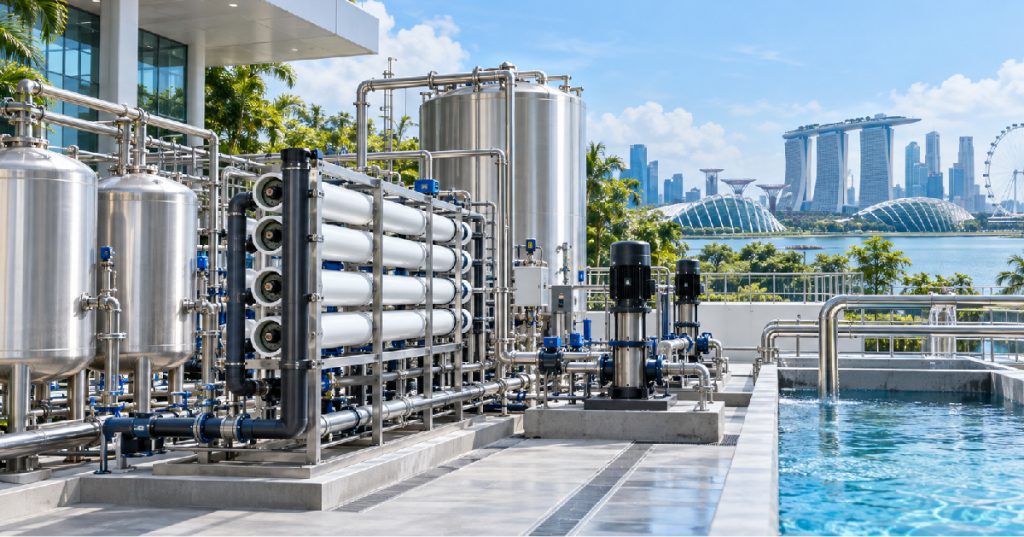
Strong water treatment solutions Singapore providers should be able to connect the treatment objective to the right combination of biological, membrane, filtration, disinfection and polishing technologies.
3. Does the Company Offer More Than One Technology?
If a supplier has only one technology to sell, every problem can start looking identical. MBR Sewage Treatment may be the right biological process, but some applications also need pretreatment, reverse osmosis, ion exchange or disinfection.
A broader portfolio gives engineers more freedom to design around the actual water profile.
4. What Is the Real Lifecycle Cost?
The lowest capital quotation is not always the lowest-cost plant. Compare power consumption, membrane replacement, chemical use, sludge disposal, manpower, planned maintenance and downtime.
For industrial water treatment Singapore businesses, these assumptions should be clear upfront.
5. What Support Is Available After Commissioning?
Check whether the company provides commissioning support, troubleshooting, spares, membrane services and process optimisation. The right wastewater treatment company Singapore businesses partner with should remain involved when operating conditions change.
Why Water Reuse Should Influence the Decision
PUB notes that treated used water is further purified through advanced technologies, including membrane filtration and ultraviolet disinfection, to produce NEWater. For businesses, the broader lesson is useful: wastewater can become a resource when treatment quality is matched to the intended use.
This is one reason MBR Sewage Treatment can be strategically valuable. Its membrane separation step can provide a strong foundation for reuse, with additional polishing or disinfection added where required.
For facilities considering industrial wastewater treatment Singapore solutions, wastewater treatment can support compliance while also contributing to water recovery and stronger operating resilience.
Why Ion Exchange Fits a Total Water Strategy
Ion Exchange Asia Pacific Pte. Ltd. has been established in Singapore since 2003 and positions itself as a total water and environment management company. Its portfolio covers water treatment, wastewater treatment, membranes, resins, specialty chemicals, instrumentation and automation, alongside service support.
That breadth gives businesses access to integrated water treatment solutions Singapore projects may require—from raw-water and process-water treatment to sewage, effluent, recycle and reuse systems.
Ion Exchange also offers its INDION Membrane Bio-Reactor, which integrates submerged membrane filtration with biological treatment for wastewater applications.
A water treatment system Singapore manufacturers, hotels or commercial facilities require may need to solve several issues at once: limited space, variable wastewater, reuse targets and future expansion. MBR should therefore be evaluated within the full water balance of the facility.
Choose the Partner, Not Just the Plant
The best treatment plant is not necessarily the one with the longest equipment list. It is the one designed around actual water quality, realistic operating conditions, compliance requirements and what the business may need in the future.
When comparing suppliers, look closely at engineering depth, technology range, lifecycle economics and after-sales capability. Those factors will influence performance long after the tender is closed.
If your facility is planning MBR Sewage Treatment, upgrading an existing wastewater plant or evaluating a new reuse strategy, speak with Ion Exchange Singapore about a solution designed around your specific treatment and operating requirements.
Frequently Asked Questions
What Is MBR in Sewage Treatment?
A membrane bioreactor combines biological wastewater treatment with membrane filtration. The membranes separate treated water from biomass, helping produce high-quality effluent within a relatively compact footprint.
Is MBR Suitable for Businesses in Singapore?
It can be, particularly where space is limited, treated-water quality needs are high or reuse is being considered. Suitability should still be confirmed through wastewater analysis and process design.
How Do I Choose a Water Treatment Company in Singapore?
Compare process expertise, regulatory understanding, technology range, project references, lifecycle costs and after-sales support. A strong supplier should understand your wastewater before recommending equipment.
Can Treated Wastewater Be Reused?
Yes, in suitable applications and with the required treatment quality. Additional polishing or disinfection may be necessary depending on how the recovered water will be used.
What Technologies May Be Included in an Industrial Water Treatment System?
Depending on the application, a system may combine pretreatment, biological treatment, filtration, membranes, ion exchange, reverse osmosis, disinfection, monitoring and automation.